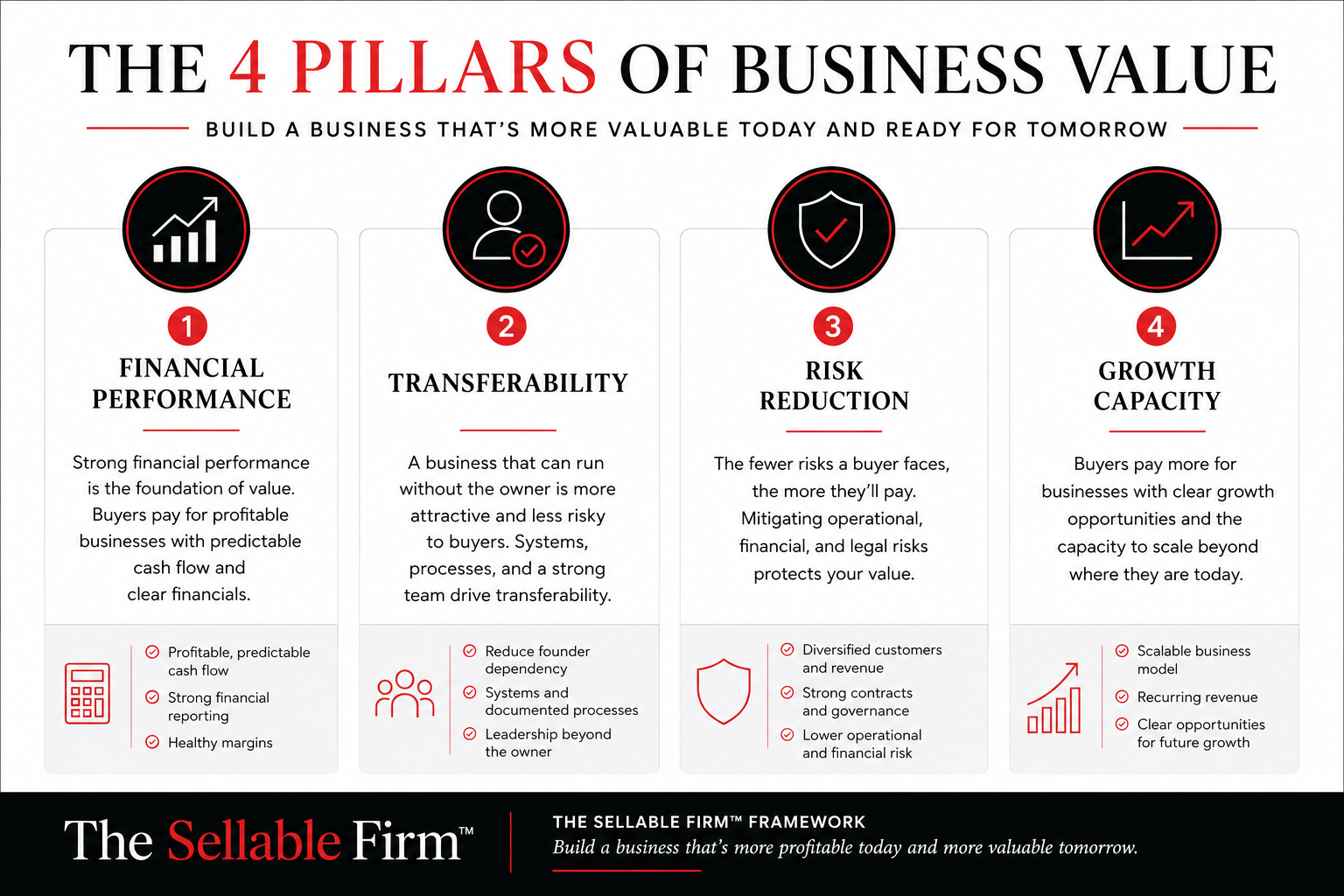
The Sellable Firm™ Framework: The Four Pillars of Building Business Value
For many business owners, success is measured by revenue.
Hit the next million dollars in sales. Hire more people. Add more customers. Open another location.
While those are certainly signs of growth, they don't necessarily create business value.
I've met countless founders who built impressive companies only to discover that when it came time to sell—or simply step back from the day-to-day—their business wasn't worth nearly what they expected.
The reason is simple.
Owners value the past. Buyers pay for the future.
A buyer isn't purchasing the years of sacrifice, late nights, or personal investment that built the company. They're investing in future cash flow and asking one critical question:
"Can this business continue to succeed without the current owner?"
That's why I developed The Sellable Firm™ Framework.
It's a practical framework built around four pillars that increase the value of a business while making it stronger, more profitable, and easier to own today. Whether your exit is three years away, ten years away, or not even on your radar, strengthening these four areas creates a business that gives you more freedom, more choices, and greater long-term wealth.
Book your free discovery call with Melissa today!
Pillar 1: Financial Performance
Financial performance is the foundation of business value.
Without strong financial performance, even the best products, strongest brands, and most loyal customers won't command premium valuations.
Buyers are looking for businesses that consistently generate profits, produce predictable cash flow, and demonstrate financial discipline.
This means focusing on:
Healthy operating margins
Predictable and recurring cash flow
Reliable financial reporting
Strong budgeting and forecasting
Sustainable profitability
Too often, business owners celebrate revenue growth while ignoring whether that growth actually creates wealth.
Growing from $5 million to $8 million in revenue sounds impressive—unless profit margins shrink, cash flow becomes strained, and working capital requirements continue increasing.
Sophisticated buyers know the difference.
According to McKinsey & Company, the long-term value of any business is ultimately driven by its ability to generate future cash flows and earn attractive returns on invested capital—not simply by growing revenue. Businesses that consistently produce predictable earnings are far more valuable because they reduce uncertainty for investors and acquirers.
Financial performance isn't simply about producing accurate financial statements.
It's about creating financial clarity that allows better decisions today while increasing enterprise value tomorrow.
Pillar 2: Transferability
One of the largest hidden discounts in privately held businesses is founder dependency.
Many owners unknowingly become the centre of everything.
They're the primary salesperson.
They approve every important decision.
Customers insist on working directly with them.
Employees rely on them to solve every problem.
From the owner's perspective, this demonstrates commitment.
From a buyer's perspective, it's a significant risk.
If the business depends on one individual, what happens when that individual leaves?
Transferability is the ability of a business to continue operating successfully without the owner's daily involvement.
That requires intentionally building a company where value resides in the organization—not the founder.
This includes:
Documented systems and operating procedures
A capable leadership team
Delegated authority
Strong client relationships across the organization
Sales processes that don't depend on one individual
Ironically, businesses that become more transferable are also more enjoyable to own.
Owners gain flexibility.
Employees become empowered.
Decision-making improves.
The company becomes capable of growing beyond the owner's personal capacity.
Reducing founder dependency isn't about making yourself unnecessary.
It's about making your business sustainable.

Book your free discovery call with Melissa today!
Pillar 3: Risk Reduction
Every acquisition is fundamentally a risk assessment.
Before buyers think about upside, they evaluate downside.
They're asking:
Could key customers leave?
Are profits sustainable?
Is the management team stable?
Are contracts enforceable?
Are operations well documented?
Could unexpected liabilities emerge?
The more uncertainty buyers perceive, the more they reduce the price they're willing to pay.
Risk reduction focuses on systematically eliminating avoidable threats to future performance.
Examples include:
Diversifying customers and revenue sources
Strengthening supplier relationships
Improving financial controls
Updating legal agreements
Strengthening cybersecurity
Developing succession plans
Reducing operational bottlenecks
Many owners become accustomed to working around these risks because they've lived with them for years.
Buyers don't have that luxury.
They evaluate businesses objectively, and uncertainty always carries a financial cost.
Deloitte notes that organizations that proactively identify and manage operational, financial, regulatory, and strategic risks strengthen enterprise value by improving resilience, protecting cash flow, and increasing investor confidence. Businesses with disciplined risk management aren't simply safer—they're more valuable.
Reducing risk also benefits owners long before an exit.
Businesses with fewer surprises experience stronger cash flow, lower stress, better decision-making, and greater resilience during economic uncertainty.
Pillar 4: Growth Capacity
Buyers don't pay for where your business has been.
They pay for where it can go.
Growth capacity measures your company's ability to increase revenue and profits without requiring dramatically more owner involvement or disproportionately increasing risk.
Scalable businesses command higher valuations because future earnings appear more achievable.
Characteristics of strong growth capacity include:
Scalable operating systems
Strong market positioning
Opportunities for geographic or service expansion
Efficient technology and automation
Capacity to grow without significant operational disruption
Growth isn't simply about selling more.
It's about building an organization capable of delivering more value efficiently.
A company that requires the owner to personally drive every sale, manage every project, or solve every operational issue has limited growth capacity.
On the other hand, businesses with repeatable systems, standardized delivery, recurring revenue, and empowered teams create confidence that future growth is sustainable.
That's exactly what buyers want.

Book your free discovery call with Melissa today!
Why the Four Pillars Work Together
The true strength of The Sellable Firm™ Framework lies in how each pillar reinforces the others.
Strong financial performance provides the resources needed to invest in systems, people, and innovation.
Greater transferability reduces dependence on the owner, making growth more sustainable.
Lower risk increases buyer confidence and protects profitability.
Growth capacity creates future earnings that justify premium valuations.
Neglect one pillar and the others become weaker.
Strengthen all four together and you build a business that's resilient, scalable, and positioned for long-term success.
Perhaps most importantly, these pillars don't just improve your eventual exit—they improve your experience as an owner.
You'll make decisions with greater confidence because your financial information is clearer.
Your team will solve more problems without you.
Unexpected risks become manageable instead of overwhelming.
Growth becomes intentional rather than chaotic.
The business starts working for you instead of because of you.
Build a Business That Gives You More Choices
One of the biggest myths about building a sellable business is that it's only relevant if you intend to sell.
Nothing could be further from the truth.
Everything that increases enterprise value also creates a better business today.
More predictable cash flow.
Stronger leadership.
Lower risk.
Greater scalability.
Less owner dependence.
Those improvements create something every entrepreneur wants: options.
Whether you eventually sell your company, pass it to the next generation, transition to management, or continue owning it for decades, building a valuable business gives you more control over your future.
That's the purpose of The Sellable Firm™ Framework.
Not simply preparing your business for sale.
But building a business that's more profitable today, more valuable tomorrow, and capable of creating lasting wealth for you and your family.
Ready to Increase the Value of Your Business?
Most business owners know they can improve their business—but very few know which improvements will have the greatest impact on value.
Our Business Value Growth Assessment identifies exactly where your business stands across the four pillars of The Sellable Firm™ Framework and provides a clear roadmap for increasing enterprise value.
Your assessment includes:
A comprehensive financial performance analysis
An assessment of the 8 Drivers of Business Value
A transferability and founder dependency review
A business risk assessment
A preliminary valuation
A Value Gap Analysis
A prioritized 12- to 24-month action plan to increase profitability and business value
If you're building a business you hope will become your greatest financial asset, don't leave its value to chance.
Book a discovery call today to learn how The Sellable Firm™ Framework can help you build a business that's stronger today, commands a premium tomorrow, and gives you the freedom and choices you've worked so hard to achieve.

Book your free discovery call with Melissa today!